The most formative years of a life
By a child's sixth birthday, the vast majority of the brain's foundational architecture is already in place. The years from two to six are not a warm-up for “real” school later — they are the main event for language, movement, order, independence, and the first sense of self. Maria Montessori understood this a century before modern neuroscience confirmed it, and the whole method is built to meet these years on their own terms rather than treating young children as small versions of older students. Understanding what is actually happening inside a two-, three-, or four-year-old changes how you see almost everything they do — including the parts that look like misbehavior.
The absorbent mind
Montessori described the young child as having an absorbent mind — a nearly effortless, almost photographic capacity to take in everything from the surrounding environment and build it into the self. A toddler learns their native language with no formal lessons at all, simply by living inside it; a child absorbs the habits, order, courtesy, and even the emotional tone of their home the same way. This is why environment matters so much before age six: children are not just learning in their surroundings, they are being formed by them. A calm, orderly, respectful environment does not just teach calm and order — it builds them into who the child is becoming.
Sensitive periods
Alongside the absorbent mind, Montessori identified sensitive periods — windows when a child is powerfully, almost irresistibly drawn to master one particular thing: language, order, tiny objects, refined movement, social manners. During a sensitive period, learning that skill feels effortless and joyful; the child seeks it out and repeats it endlessly. Miss the window, and the same learning is still possible but takes far more conscious effort later. Much of what puzzles parents makes sense through this lens. The two-year-old who must have the cup in the same spot every night is in the sensitive period for order. The toddler fascinated by crumbs and buttons is in the sensitive period for small objects. The child who wants to hear the same book forty times is doing exactly the developmental work their brain is wired for right now.
The drive toward independence
If there is one engine running underneath the early years, it is the drive toward independence. “Help me to do it myself” is, in a sense, the child's entire agenda from two to six. A young child who insists on putting on their own shoes — slowly, imperfectly, while everyone waits — is not being difficult; they are answering a deep developmental need to become capable. Montessori environments are built to feed this drive: real tools sized for small hands, low shelves and hooks, practical-life activities like pouring, buttoning, sweeping, and food preparation. Every time a child does something real for themselves, they are not just learning a skill — they are building the belief that they are competent, which is the quiet foundation of confidence and resilience for the rest of childhood.
Movement and the developing mind
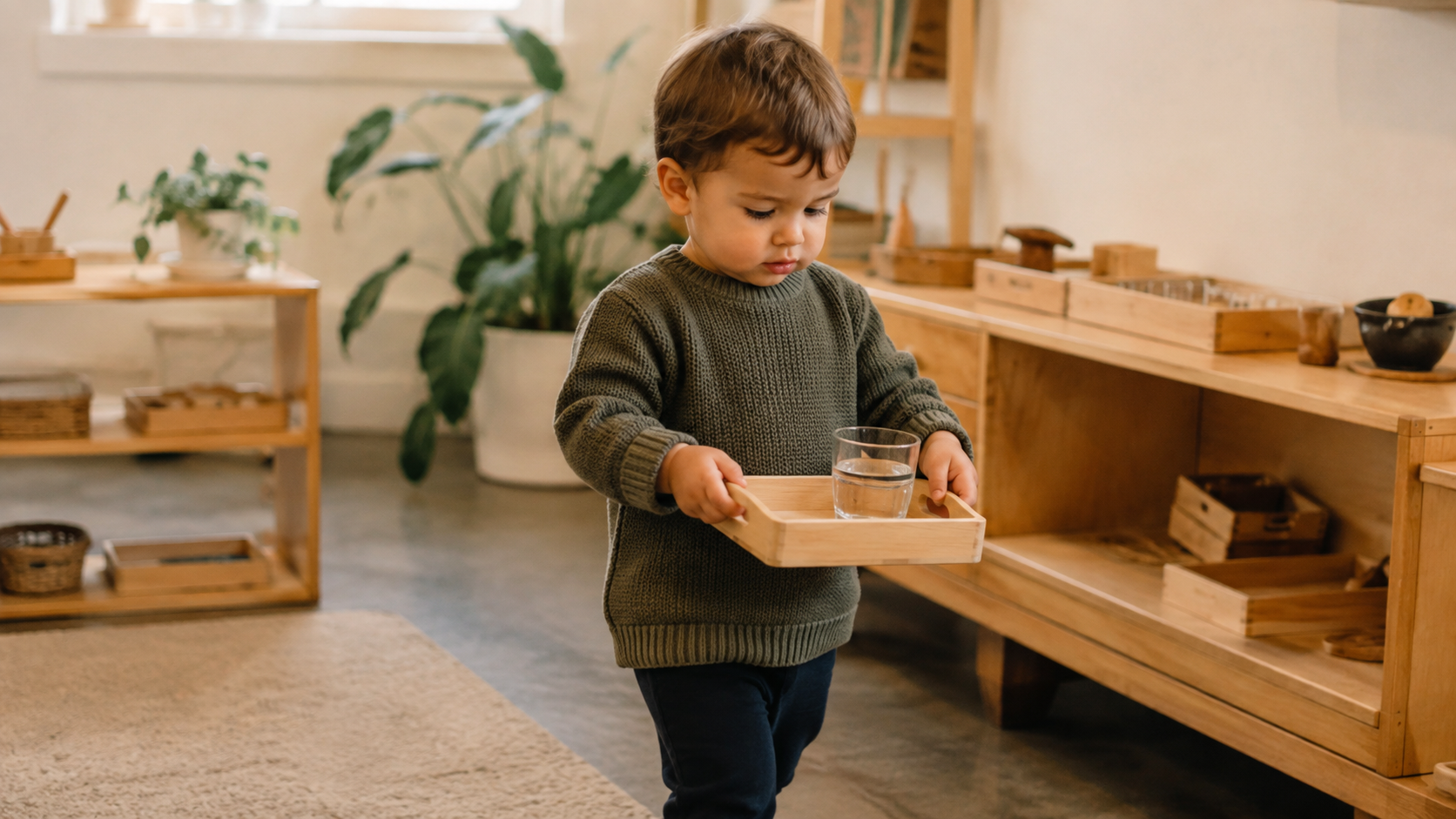
For young children, thinking and moving are not separate. The hand is, as Montessori put it, the instrument of the mind — which is why so much early learning has to be physical to stick. Carrying a tray without spilling, walking carefully around a work mat, manipulating small materials, refining the pincer grip that will one day hold a pencil: this is cognitive development, not a break from it. Trying to teach a four-year-old primarily by sitting them still and talking at them works against the way their brain is built. Montessori classrooms honor movement as part of learning, which is one reason children in them can concentrate so deeply — their bodies are engaged, not suppressed.
Reading the “difficult” moments differently
Understanding development also reframes the hard moments. The meltdown over a sandwich cut the “wrong” way, the insistence on a rigid routine, the endless repetition, the fierce “no” — these are usually not defiance but development in progress: the sensitive period for order asserting itself, a bid for independence, a nervous system still learning to regulate. Seeing them this way does not make them disappear, but it changes the adult's response from correction to guidance, which is exactly what a young child needs. It is also why Montessori environments lean so heavily on consistency, order, and respect — they lower the friction of these years for everyone.
Meeting each stage as it comes
The practical payoff of understanding early development is simple: you stop pushing children toward the next stage and start meeting them fully in the one they are in. You offer language richly during the language window, order during the order window, real independence during the independence years. That is the whole logic of a Montessori classroom for ages two through six — a prepared environment that puts the right opportunity within reach at exactly the moment a child is most ready to seize it. Get these years right, and you are not just preparing a child for kindergarten; you are laying the groundwork for how they will learn, work, and relate to the world for the rest of their lives.