Not what “school” usually looks like
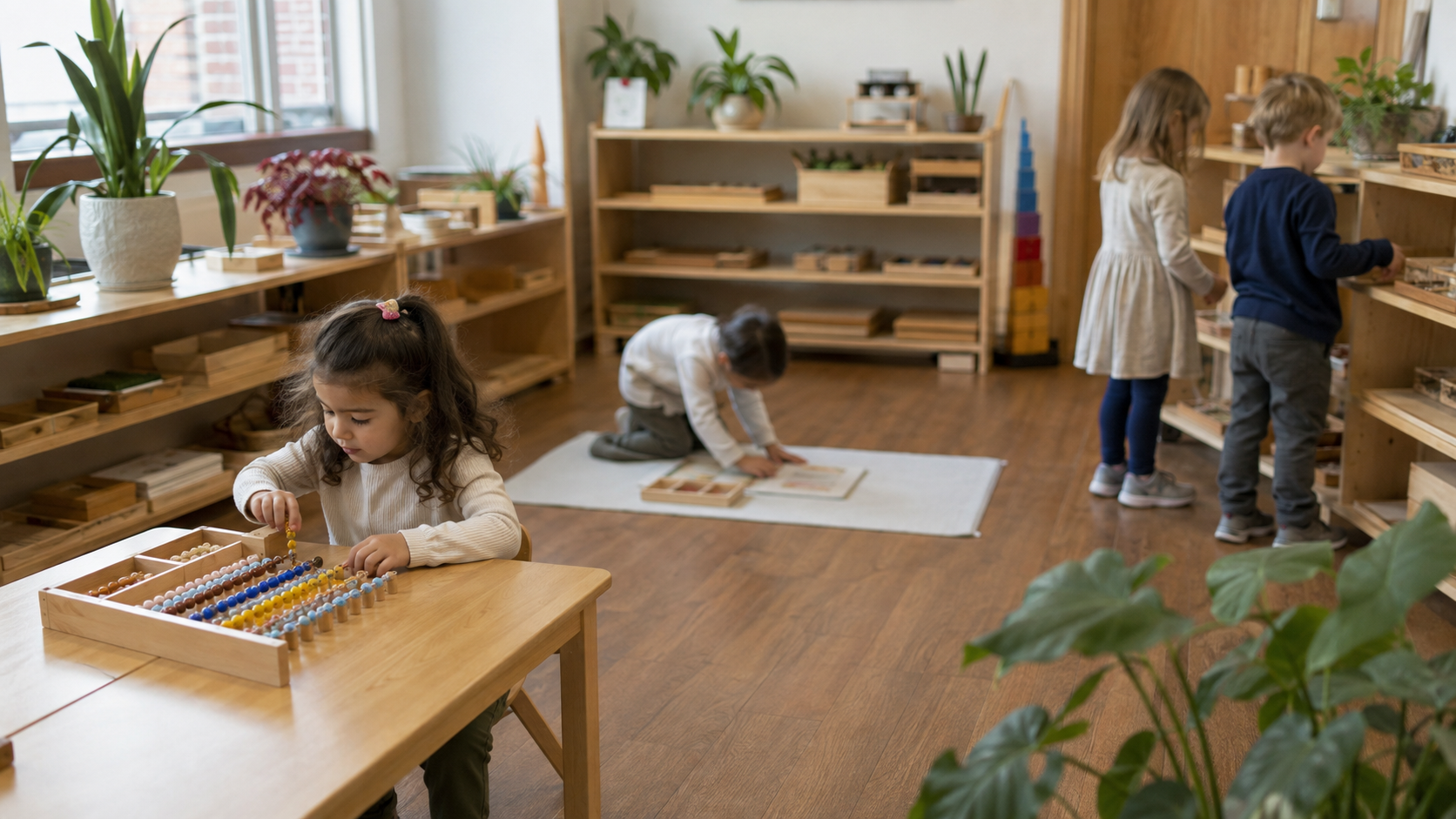
Parents are often surprised the first time they observe a Montessori classroom. There is no teacher at the front, no rows of desks, no whole-group lesson with thirty children doing the same worksheet. Instead the room is calm and quietly busy: children spread across the space, each absorbed in their own work, some at small tables, some on floor mats, moving purposefully, talking softly. It does not look like a typical preschool — and that difference is the whole point. What you are seeing is a carefully designed community where children do the real work of learning themselves.
The uninterrupted work cycle
The backbone of the Montessori morning is the work cycle — a long, unbroken block, often around three hours, in which children choose their own activities and move through them at their own pace. This long stretch is essential and deliberate. Deep concentration takes time to build, and it shatters if a bell rings every twenty minutes. Given the time and freedom, children settle into remarkable focus, often returning to the same material again and again until they have truly mastered it. That freedom is the opposite of chaos: because children select work that matches what they are developmentally ready for, they become deeply engaged rather than restless.
A morning in the life
Watch one child and you will see the rhythm. They arrive, choose their work from a low shelf, carry a tray carefully to a mat they have unrolled, and settle in — perhaps with a set of materials for building words, or a tray of practical-life work like pouring and transferring. They work, sometimes for a long time, then return everything to its exact place before choosing again. A guide kneels beside another child, giving a quiet, precise lesson, then moves on. Snack is available at a small table where children serve themselves and clean up when they are done. Outdoor time, group gatherings, and songs punctuate the morning, but the long work cycle is the heart of it.
The mixed-age community
A Montessori classroom usually spans three years of age, and it functions like a small, real community rather than a grade. Younger children learn constantly by watching the older ones — absorbing skills and social norms far beyond what a same-age room could offer. Older children deepen their own understanding by helping the younger ones and grow into natural leaders. Because there is a wide range of ability in the room, no child is “behind” or “ahead” — each simply works at their own level, and the community holds all of it comfortably. At Montessori of Brea this spans our toddler and primary years and into kindergarten and first grade.
Grace and courtesy
Woven through the whole day are lessons in what Montessori called grace and courtesy — how to greet a visitor, wait for a turn, carry scissors safely, ask for help, resolve a disagreement, push in a chair. These are not afterthoughts; they are taught as deliberately as reading and math, because they are what make a room full of freely-moving young children function as a community. It is a large part of why Montessori classrooms feel so respectful: children are not just told to be kind, they are shown exactly how, and given the freedom to practice it all day long.
The guide's quiet role
The adult in a Montessori classroom is called a guide, and their job is not to be the center of attention. It is to prepare the environment, observe each child closely, give a precise lesson at the moment a child is ready, and then step back and protect the concentration that follows. Much of the time the guide is watching, not directing — which is exactly why the children look so independent. A great Montessori guide does an enormous amount of invisible work so that the visible work belongs to the children.
Why it looks so calm
Put it all together — real choice, long uninterrupted time, self-correcting materials, a mixed-age community, explicit courtesy, and an adult who guides rather than commands — and the famous calm of a Montessori classroom stops being mysterious. The children are calm because they are genuinely engaged in meaningful work they chose, in an environment built to help them succeed. What can look, at first glance, like an unusually relaxed classroom is in fact a deeply intentional one, and it is why children so often leave it both capable and content.