A method built on observing children, not managing them
The Montessori method did not begin with a curriculum. It began with observation. In the early 1900s, Dr. Maria Montessori — one of Italy's first female physicians — watched children with the eyes of a scientist and noticed something most schools still overlook: when children are given the right environment and the freedom to move through it, they teach themselves. They choose work that meets a genuine developmental need, they repeat it with astonishing focus, and they emerge calmer and more capable. Everything that looks distinctive about a Montessori classroom — the child-sized furniture, the beautiful wooden materials, the long uninterrupted work periods, the unusually peaceful atmosphere — grows out of that single insight. At Montessori of Brea, it has guided our classrooms since 1969.
The prepared environment
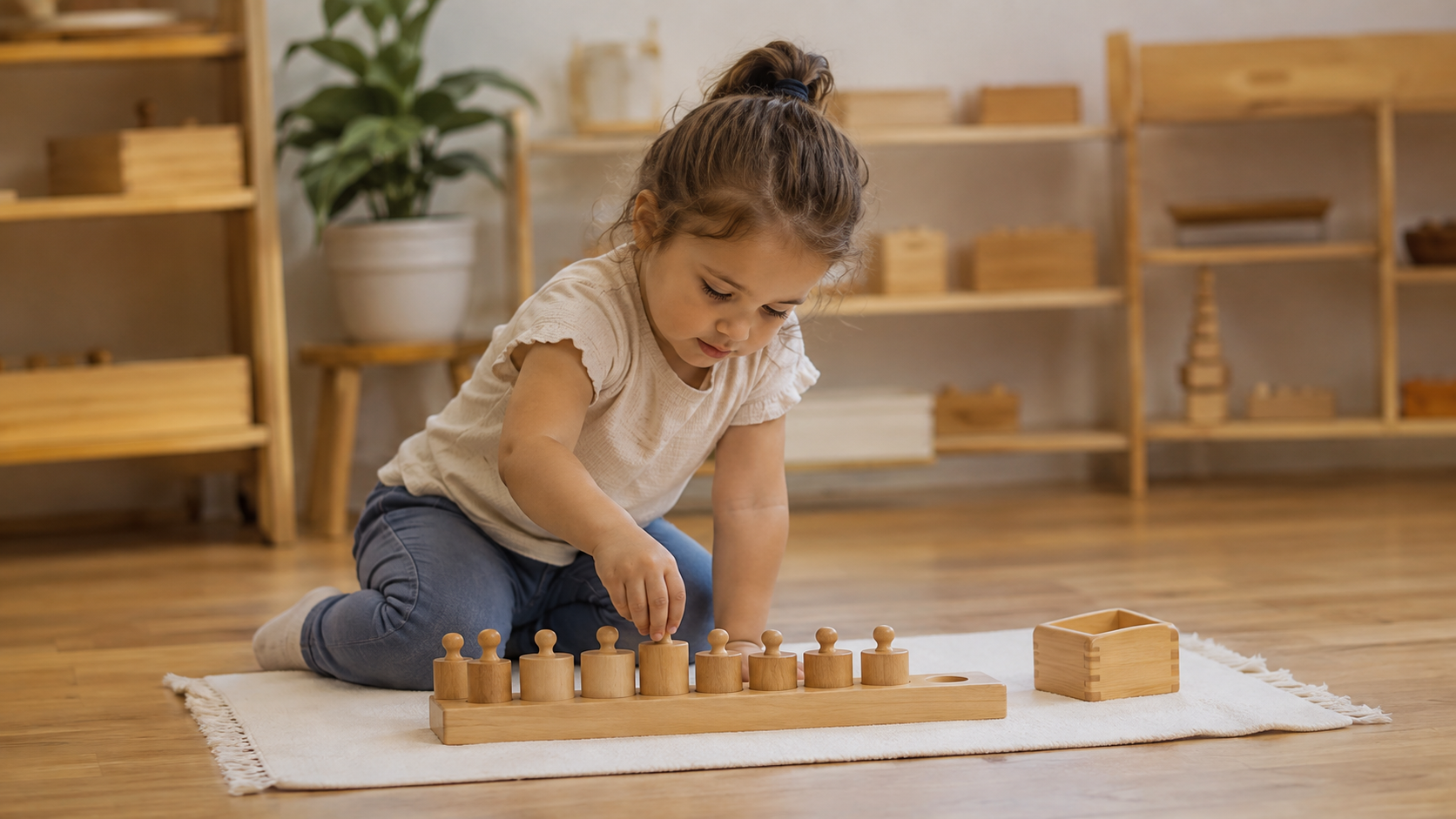
The heart of the method is what Montessori called the prepared environment. Instead of a room arranged for a teacher to deliver lessons to a seated group, a Montessori classroom is arranged for children to work. Materials sit on low, open shelves within a child's reach, ordered from simple to complex and from concrete to abstract. Everything has a place, and everything is real: glass pitchers a child can break, small tools that actually work, plants and sometimes animals to care for. This is not decoration. A carefully prepared environment does the job a lecturing adult cannot — it lets a child follow their own curiosity, correct their own mistakes, and take on exactly the challenge they are ready for, without waiting for permission.
Hands before heads: the Montessori materials
Montessori materials are the part most visitors remember, and they are widely misunderstood as “educational toys.” They are not toys; each is a precise tool that isolates one concept and makes it physical. A child builds the Pink Tower and feels dimension in their hands before it is ever a word. They trace Sandpaper Letters and feel the shape of a sound before they write it. They lay out the Golden Beads and hold the decimal system — units, tens, hundreds, thousands — as real quantities they can carry across the room, long before the arithmetic becomes abstract on paper. Because the materials are self-correcting, a child usually sees their own error and tries again without an adult stepping in. Learning becomes something a child does, with their whole body, rather than something delivered to them.
Freedom within limits
Montessori classrooms give children real freedom — to choose their work, to move, to repeat an activity as many times as they like, to work alone or beside a friend. But it is freedom within limits: you may choose any work you have had a lesson in, you treat the materials and the people with care, and you return your work for the next child. That balance is the method's quiet engine. The freedom is what produces the deep concentration and self-motivation Montessori is known for; the limits are what make a room full of freely-moving young children feel so orderly. Children raised this way do not just follow rules — they build the inner discipline to make good choices when no one is watching.
The three-year cycle and the mixed-age classroom
Montessori groups children in three-year age spans — toddlers together, then the primary years (roughly 3 to 6), then elementary. This looks unusual and is one of the method's most powerful features. Younger children learn constantly from watching older ones, absorbing skills and social norms far beyond what a same-age room could offer. Older children consolidate their own understanding by helping the younger ones — there is no deeper way to learn something than to teach it — and they grow into leadership naturally. Over three years the guide comes to know each child profoundly, and each child moves through the material at their own pace. At Montessori of Brea this arc runs from our toddler program through the primary years and into kindergarten and first grade.
The role of the guide
Montessori teachers are called guides for a reason. The guide's work is not to fill children with information but to connect each child to the environment: to observe closely, give a precise lesson at the moment a child is ready, and then step back and protect the concentration that follows. It is a demanding, disciplined role — harder in many ways than delivering a standard lesson — and it is why authentic programs invest in genuinely trained guides. What it produces is a classroom where the adult is rarely the center of attention, because the children are busy doing the real work of learning themselves.
Why it works — and what it grows
Put these pieces together and the reason the method works becomes clear. Children learn best when they are interested, and interest cannot be commanded — it has to be freed. The prepared environment frees it; the materials make ideas concrete enough to grasp; freedom within limits turns interest into concentration; the mixed-age community turns concentration into confidence and character. Families who choose Montessori are often surprised that the lasting result is not just early academic strength — though that is real — but children who are independent, focused, considerate, and genuinely in love with learning. Understanding the method is the best way to see why a Montessori day looks so different from a conventional preschool, and why, more than a century after Maria Montessori's first classroom, it still does exactly what she observed it could.