
Every parent has watched it happen: a toddler who insists their cup goes in exactly the same spot every night, or a three-year-old who suddenly cannot stop asking "what is that?" about every object in the grocery store. These are not quirks to be managed. They are signs of something remarkable happening in your child's brain.
Dr. Maria Montessori called them sensitive periods — windows of time when a child is powerfully, almost effortlessly, drawn to master a particular kind of learning. Modern neuroscience has a matching idea: these are the years of greatest brain plasticity, when certain connections form more easily than they ever will again.
Understanding them changes how you see your child's behavior — and why the early years matter so much.
What a sensitive period feels like from the outside
During a sensitive period, a child will return to the same kind of activity again and again with deep focus and obvious joy, and get genuinely frustrated when they are blocked from it. It is not stubbornness — it is a developmental drive doing exactly what it is supposed to do.
Here are the big ones you will see between birth and about age six:
- Language (birth–~6). Children absorb the sounds, words, and grammar of the languages around them without formal lessons.
- Order (~1–3). That insistence on routine and "everything in its place" is not rigidity; a predictable, orderly environment helps a young child make sense of the world. It is why a calm, well-organized classroom matters so much.
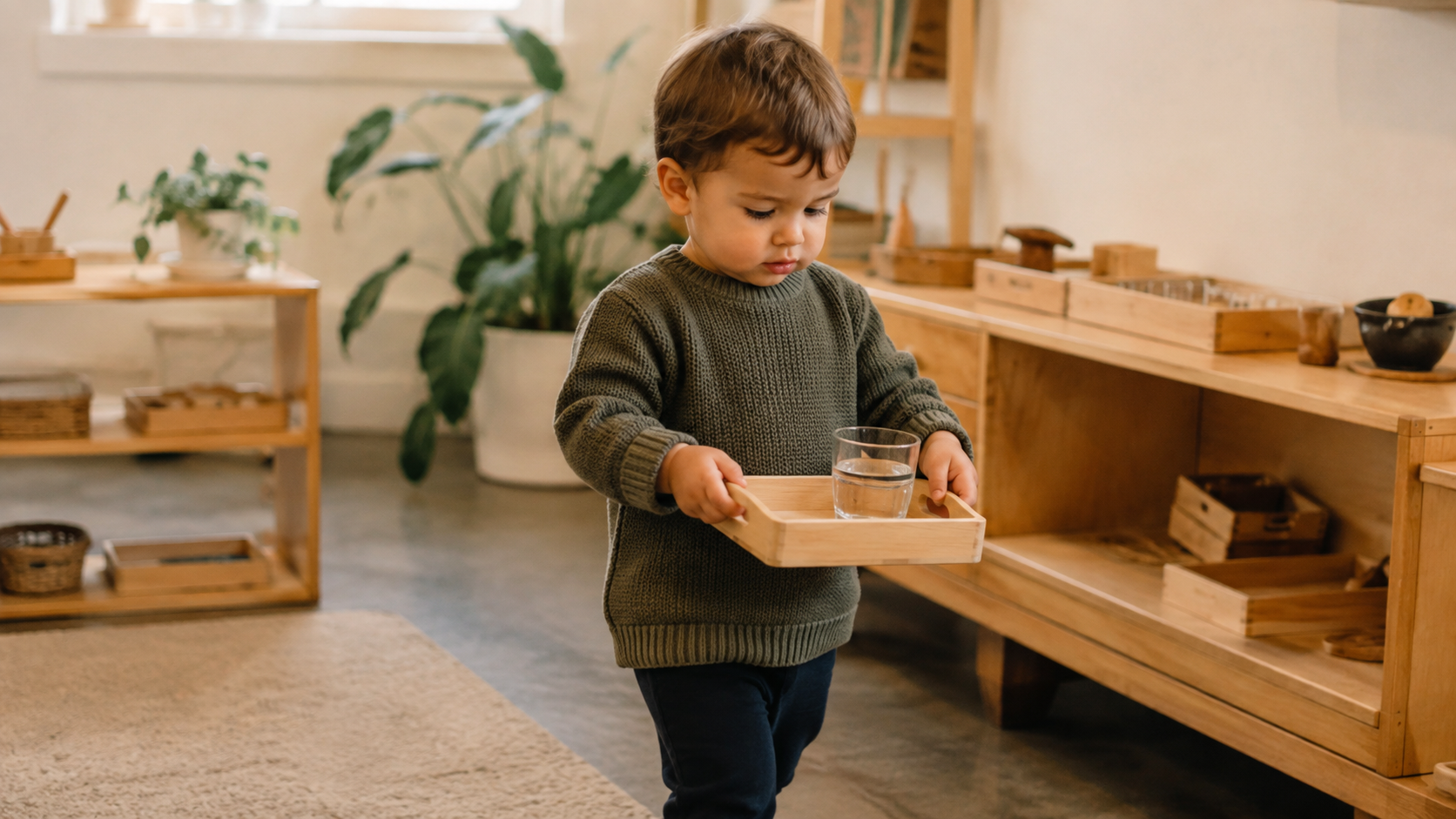
- Movement and coordination (~1–4). Pouring, carrying, buttoning, using scissors — children crave chances to refine small and large motor skills. What looks like "just playing" is serious developmental work.
- Small objects and detail (~1.5–3). The fascination with tiny things — a crumb, an ant, a bead — is the brain training itself to notice and attend.
- Numbers and math (~4–6). A natural pull toward counting, quantity, and sequence, right when hands-on math materials can turn it into real understanding.
Why the window matters
Skills learned during their sensitive period arrive with ease and stay. The same skills learned outside that window are still learnable — but they take conscious effort and repetition, the way learning a language as an adult is so much harder than as a baby.
That is the case for taking the early years seriously. Ages two to six are not a waiting room before "real" school starts. They may be the single most efficient learning window your child ever has.
How to support each period at home
You do not need special materials — you need to notice what is pulling your child and make a little room for it:
- When they want to do it "myself," let them, even when it is slower and messier. That drive is the movement and independence periods at work.
- Keep routines predictable and spaces uncluttered. Order on the outside builds order on the inside.
- Talk, read, name things, and sing — constantly. You are your child's richest language material.
- Give real, doable tasks: pouring their own water, carrying their plate, watering a plant. Practical work satisfies several sensitive periods at once.
Why this shapes a Montessori classroom
A Montessori environment is designed, quite literally, around these windows. The materials, the order, the freedom to repeat an activity as many times as a child needs — all of it exists to meet the child exactly when they are most ready to learn. That is not a coincidence; it is the whole point.
Want to see how a prepared environment supports each stage? Explore our Early Childhood program for ages 2 to 5, or schedule a tour to watch it in action.