
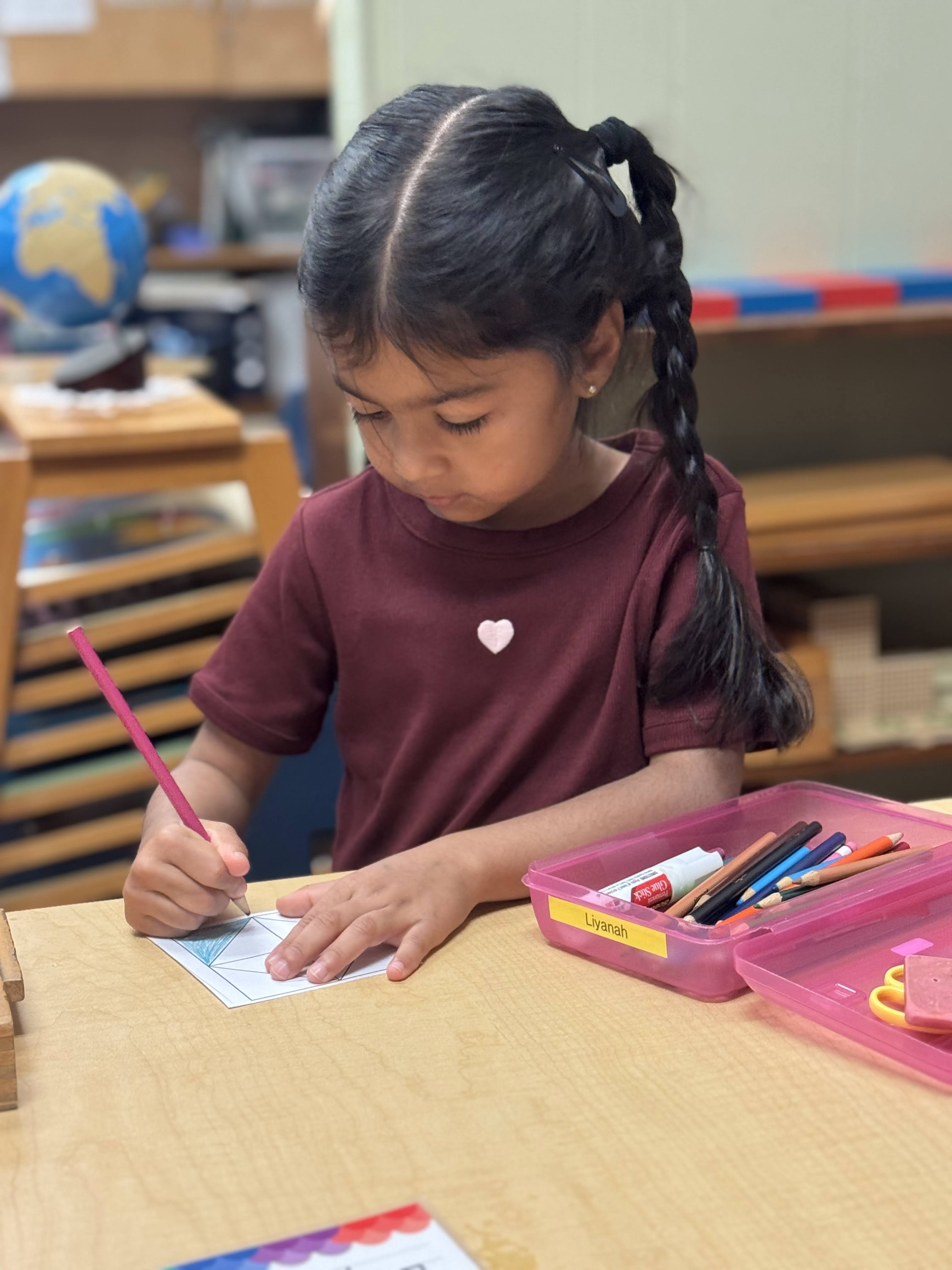
At the heart of authentic Montessori education is a deep, unwavering respect for human potential. Long before modern brain imaging confirmed how young minds learn best, Dr. Maria Montessori approached childhood development through a scientific lens. As a physician observing young children with developmental delays, she noticed something revolutionary: when provided with sensory-rich, self-correcting materials and a prepared environment tailored to their developmental needs, children demonstrated remarkable growth, focus, and joy.
That single discovery transformed our understanding of human learning. Today, at Montessori of Brea, we carry that legacy forward, providing an environment where children build the cognitive, emotional, and practical skills that serve as a foundation for life.
A Scientific Lens on Human Development
Dr. Montessori approached childhood not as a tabula rasa—a blank slate to be written upon—but as a scientist observing a natural process. She recognized that human beings possess innate, universal characteristics and follow predictable patterns of growth. At our core, we are a species biologically designed to explore, adapt, and master our surroundings.
Through years of observation, Dr. Montessori identified distinct developmental stages (the Planes of Development) and a set of universal driving forces known as the Human Tendencies. These tendencies are evolutionary forces that guide every child from birth to maturity, driving them to satisfy their intellectual, physical, and social needs.
Understanding the Human Tendencies
These universal tendencies are innate, lifelong, and evolutionary. They cannot be eliminated, but they can either be supported or thwarted by a child’s environment:
Orientation: The drive to explore and understand one’s surroundings.
Order: The need to make sense of the world and build predictable mental frameworks.
Exploration & Abstraction: Moving from concrete, hands-on sensory experience to conceptual, symbolic thought.
Work & Purpose: The innate desire to shape, adapt, and contribute to the environment.
Repetition & Precision: Practicing a skill repeatedly to master it and refine executive function.
Communication & Association: Connecting, collaborating, and forming meaningful bonds with others.
When an environment honors these tendencies, children blossom into focused, self-directed learners. Conversely, when these drives are blocked, children still attempt to meet their developmental needs—often through restlessness, frustration, or behavioral disruption.
Education as an "Aid to Life"
Instead of forcing a standardized, teacher-led curriculum onto young minds, authentic Montessori education respects and reinforces the natural unfolding of each child’s abilities. In our prepared classrooms:
The Guide’s Role Shifts: Our credentialed educators serve as observers and guides—aides to life—who carefully prepare the environment and introduce materials when a child shows individual readiness.
Independence Meets Structure: Children exercise freedom within limits, choosing purposeful work, developing deep concentration, and mastering self-regulation within a predictable, safe framework.
Learning Is Embodied: Children manipulate concrete mathematical and language materials with their hands, physically encoding concepts into memory before transitioning to abstract reasoning.
Cultivating Stewardship and Global Awareness
Dr. Montessori’s vision went far beyond individual academic achievement. She viewed human beings as interconnected parts of a broader cosmic web, where each individual plays a role in maintaining harmony and balance.
At Montessori of Brea, we embrace this perspective by fostering global awareness, empathy, and environmental stewardship. Through multi-age collaboration, Spanish language instruction, and daily care for our classroom environment and community, children learn humility, wonder, and respect for the world around them. Education is not simply about academic milestones; it is about raising mature, adaptive, and compassionate human beings.
Observation in Action
To truly support development, Montessori-trained guides practice continuous, careful observation. We look beneath surface behaviors to understand what developmental drive or Human Tendency a child is attempting to satisfy. This practice shifts our perspective, fostering deep respect for each child's self-construction.
Children are not empty vessels waiting to be filled with facts; they are self-constructing, naturally curious beings full of potential. When we align our home and school environments with the science of human development, we unlock confidence, capability, and a lifelong love of learning.
See the Montessori Difference in Action
We invite you to visit Montessori of Brea to observe how our carefully prepared classrooms support the natural development, focus, and independence of our students.
Schedule a Tour Today to learn more about our primary and elementary programs!