
"If persistence be the true foundation of the will, we nevertheless recognize decision as the act of the will par excellence."
— Dr. Maria Montessori, Spontaneous Activity in Education
In this foundational insight, Dr. Montessori reminds us that persistence is at the heart of true character development. Today, developmental psychologists and educators often refer to this steadiness, focus, and perseverance as "grit".
When young children work through obstacles and remain committed to their chosen activity, they are doing far more than acquiring an isolated skill. They are constructing executive function, self-regulation, and the very foundation of their individual will.
Persistence in Action
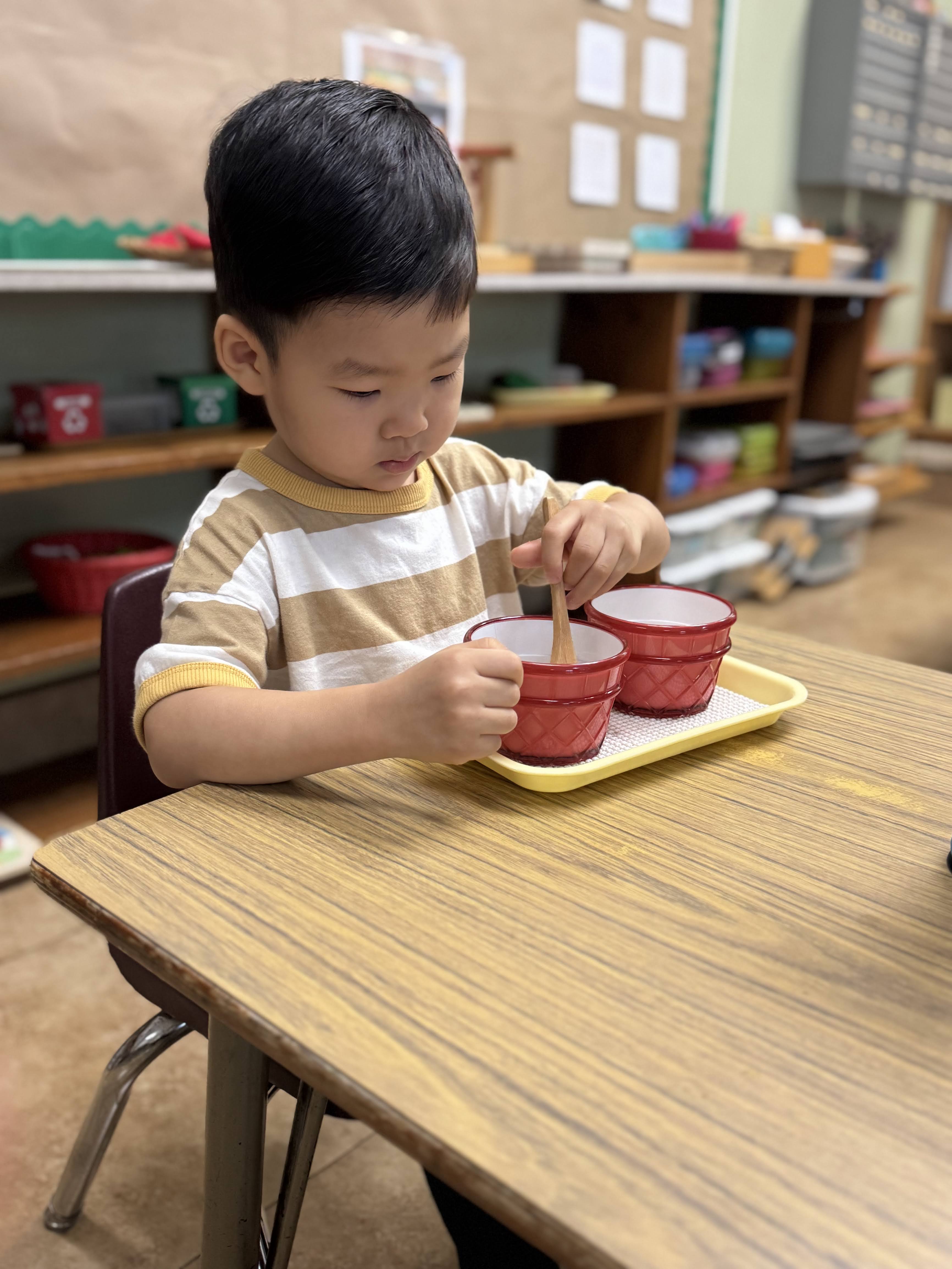
Picture a typical morning in our prepared classrooms at Montessori of Brea: A four-year-old works with the Decimal System materials, carefully building four-digit numbers using golden beads and number cards. The child remains absorbed in this complex task for an extended period, repeating the sequence with intense concentration and quiet focus. They give as much care to the precise setup and restoration of their workspace as they do to the work itself.
It is easy to envision this young person years from now as a thoughtful, responsible, and resilient adult. The four-year-old’s persistence in that quiet moment shapes their future self, strengthening their innate ability to act with purpose and confidence throughout life.
Decision: The Ultimate Act of the Will
If persistence is the foundation of the will, decision is the act of the will. Every decision arises from meaningful choice.
For growing children, the opportunity to make choices within a structured environment is essential. Just as physical movement cannot develop if a child is kept immobile, strength of will cannot develop if a child is never permitted to choose.
Our entire lives are a continual series of decisions. Practicing decision-making builds true independence. When children are denied the chance to make decisions—or when they grow fearful of making mistakes—they become dependent on external direction.
This is why structured choice is woven directly into the daily routine at Montessori of Brea. We strengthen children’s executive function by offering continuous opportunities to decide within safe, age-appropriate limits:
"Would you like to carry your work on a tray or use a work mat today?"
"You may choose any available table in the classroom."
"Would you like to return the pencil or the box to the shelf first?"
Each small, purposeful choice builds neural connections that reinforce autonomy and self-trust.
Practicing Independence Through Choice
Every time children make a decision, they practice genuine independence. They learn to trust their own judgment rather than relying solely on adult prompts. In our classrooms, children decide when to begin, when a task is complete, when to move, when to pause, and how to collaborate with peers.
As adults—both parents and educators—our role is to protect this developmental space. Just as we would never keep a toddler motionless when they are learning to crawl, walk, or run, we must not impede a child’s developing will as they learn to make decisions and act upon their environment.
"And yet we do something of the same kind when, in order to educate the child’s 'will,' we first of all attempt to annihilate it, or, as we say, 'break' it, and thus hamper the development of every factor of the will, substituting ourselves for the child in everything."
— Dr. Maria Montessori, Spontaneous Activity in Education
This serves as an important reminder for all of us. It can be easy to impose our will upon children—either through overly controlling directives or subtly by doing things for them rather than allowing them to practice and experience natural outcomes.
At Montessori of Brea, our credentialed guides work in close partnership with families to safeguard this space for choice. By doing so, we foster children's independence in the present while helping them cultivate the grit, decision-making capabilities, and strength of character that will guide them for a lifetime.