
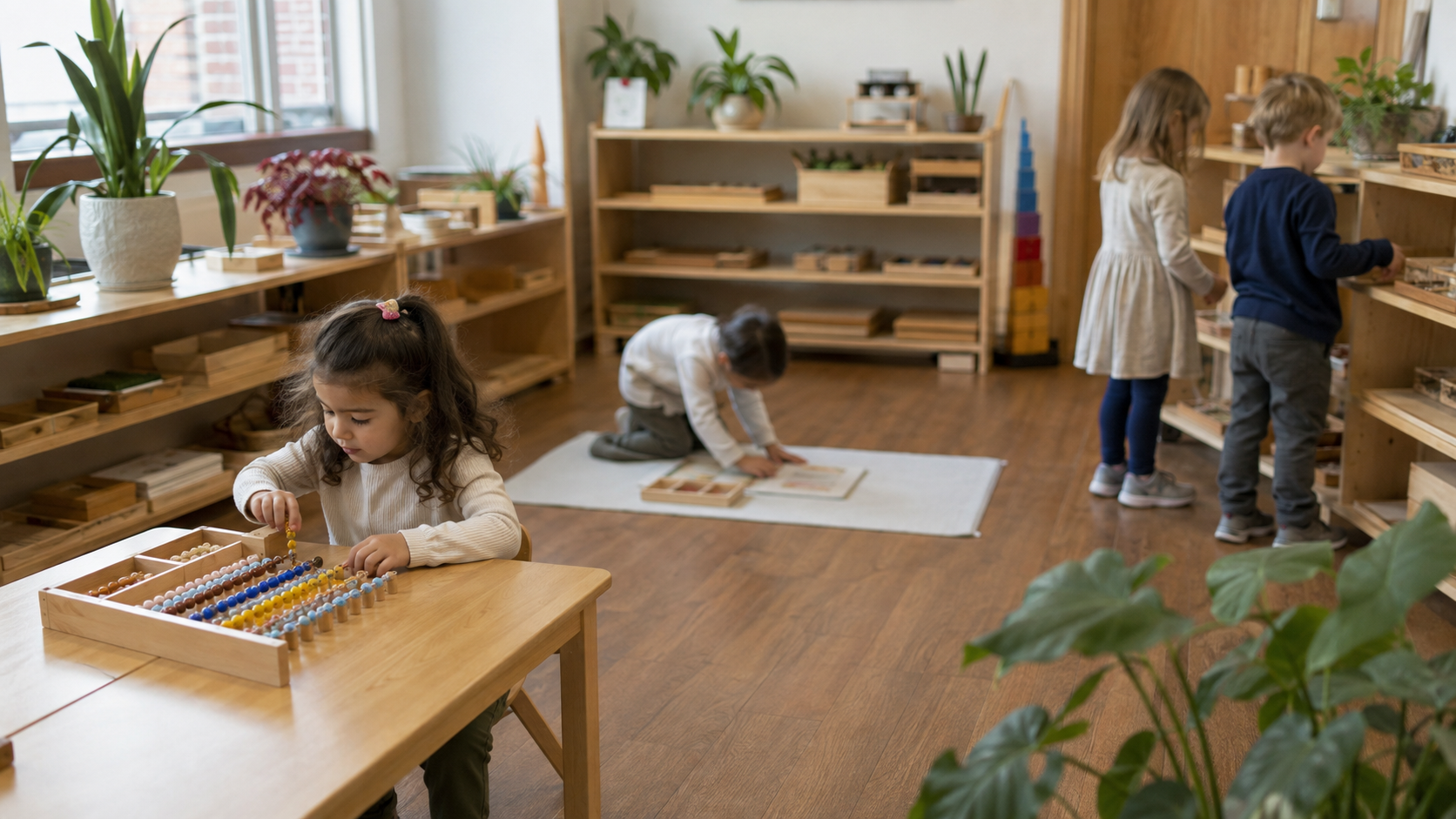
Parents touring for the first time often ask the same practical question: what does my child actually do all day? It is a fair question — a Montessori classroom looks so different from a traditional one that it can be hard to picture. So here is a real morning, start to finish, in one of our classrooms at Montessori of Brea.
It starts with the work cycle
The heart of the Montessori day is the uninterrupted work cycle — a long, unbroken stretch of time (often two to three hours) in which children choose their own work and stay with it as long as they need. There is no bell every fifteen minutes pulling them to the next thing. That length is deliberate: it is what allows a child to move past restlessness and into genuine, deep concentration.
A guide moves quietly around the room giving individual and small-group lessons — showing one child how to use a new material, checking in with another — while the rest of the class works. Children choose what they are ready for, repeat it as often as they like, and return it to the shelf for the next child. Freedom and responsibility, side by side.
The five areas of the classroom
Around the room, the materials are organized into the classic Montessori curriculum areas:
- Practical Life — pouring, spooning, buttoning, polishing, table-setting, plant care. These everyday activities build the coordination, order, and independence everything else rests on.
- Sensorial — materials that isolate one quality at a time (size, weight, color, sound, texture), training the child to observe and classify the world.
- Language — sandpaper letters, movable alphabets, and a rich spoken-language environment that carries children naturally into reading and writing.
- Mathematics — beads, spindles, and number rods that make quantity and operations concrete long before they become abstract symbols on a page.
- Cultural studies — geography, science, art, and music that open the wider world.
Because the work is hands-on and self-chosen, children are not waiting for a worksheet — they are doing mathematics, doing literacy, with their hands.
Grace, courtesy, and community
Running through all of it is a quiet emphasis on grace and courtesy — how we speak to one another, wait our turn, carry a tray, resolve a disagreement. In a multi-age classroom, younger children learn these from watching older ones, and older children grow by modeling them. The result is a room that feels calm and respectful, because the children themselves are helping to keep it that way.
By the time a child heads home, they have very likely read, counted, and spent long stretches in focused, self-directed work — without ever being made to sit still and be quiet. That is the difference a prepared environment makes.
The best way to understand a Montessori day is to see one. Schedule a tour, or explore our programs for ages 2 to 7.