
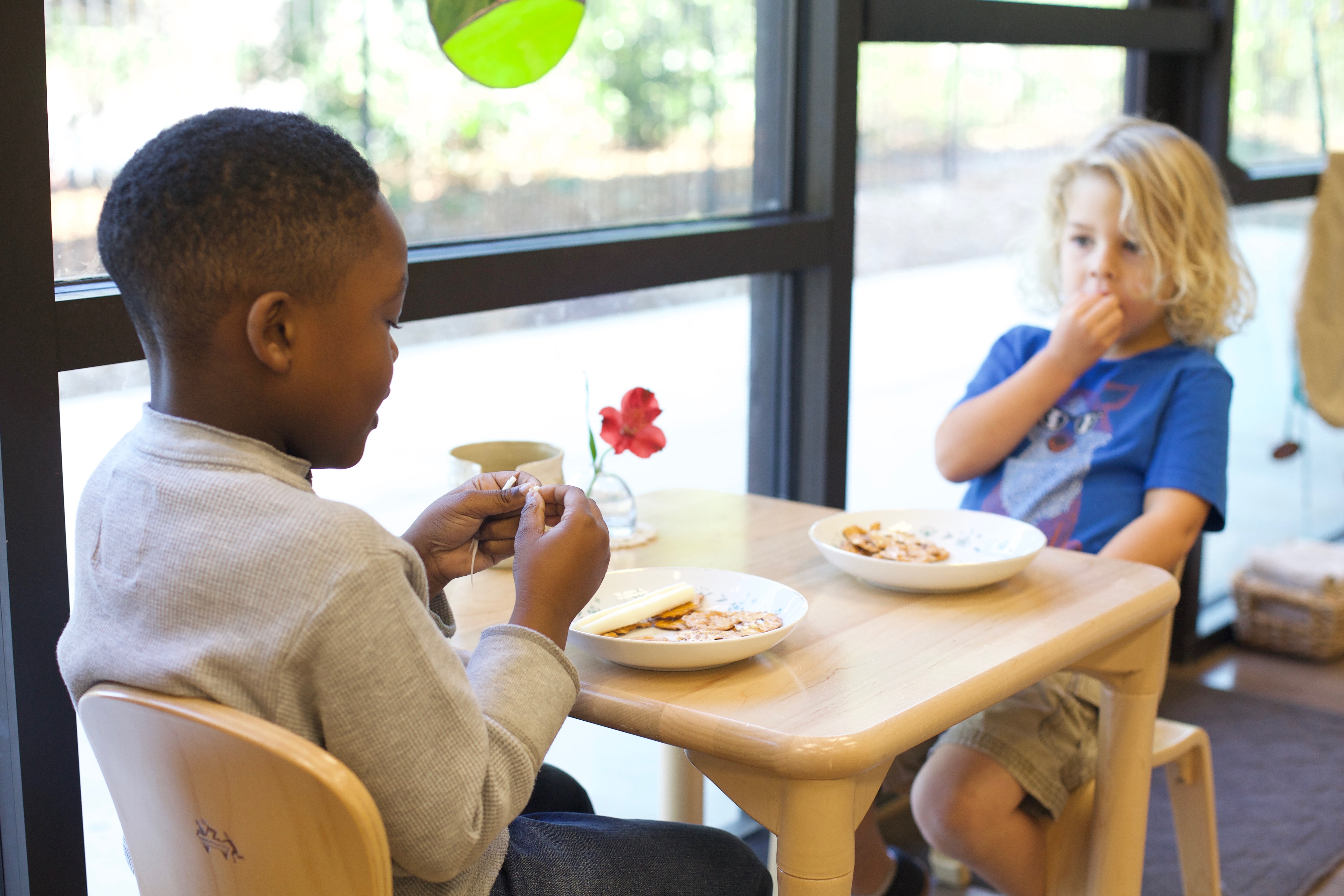
Throughout human history, survival has depended upon finding, preparing, and consuming food. It is entirely understandable why meals sit at the very center of our daily lives, family cultures, and community traditions.
At Montessori of Brea, we recognize that food plays a profound role in early childhood development. While wholesome nutrition is essential, food also offers young children a rich, multisensory foundation to explore global cultures, refine executive function, and build genuine independence.
1. Understanding the World: A Multisensory Exploration
During early childhood, children experience a natural sensitive period for refining their senses. To fully support this developmental window, children need to experience food in its natural, raw state rather than solely through prepackaged containers.
In our prepared environments, children explore fresh ingredients with all five senses:
Sensory Discovery: Observing how a raw vegetable changes in texture, color, aroma, and sound when washed, chopped, or cooked.
Connecting to Nature's Cycle: Working with seasonal produce and harvesting fresh herbs, vegetables, or fruits from planter boxes in our outdoor environment.
Understanding Plant Anatomy: Learning firsthand which parts of plants we eat—from roots (carrots) and stems (celery) to leaves (spinach), seeds (peas), and flowers (broccoli).
Rather than simply opening a package, children participate in transforming raw ingredients into homemade breads and warm soups. As students grow into the elementary years, this exploration expands into understanding food production, budgeting, and preparing complete, shared meals for their peers.
2. Mastering Movement and Physical Independence
Food preparation is one of the most engaging Practical Life activities in the Montessori primary classroom. What looks to an adult like simple kitchen work is actually a sophisticated engine for fine motor control and executive function.
Children begin with fundamental practical skills:
Basic Dexterity: Peeling, grating, slicing, juicing, and dicing.
Advanced Coordination: Safely handling a child-sized knife, following multi-step recipes, and operating real kitchen tools like hand mixers, toasters, and manual juicers.
To allow children to master these movements without unnecessary frustration, our classrooms are equipped with properly sized, functional kitchen tools scaled entirely to their hands. Through self-directed repetition, children refine their hand-eye coordination, build finger strength for future handwriting, and take pride in saying, "I made this myself!"
3. Cultivating Rich, Precise Language
Food preparation and table setting provide natural, organic opportunities for language acquisition. Rather than using generic terms, our trained guides introduce precise culinary, botanical, and mathematical terminology.
Building Mathematical and Grammatical Foundations at the Table
Setting the meal table offers an indirect, concrete lesson in mathematics and prepositions:
One-to-One Correspondence: Counting out four plates or four napkins for peers lays the physical foundation for future arithmetic.
Spatial Prepositions: Placing a fork to the left of the plate, a glass above the napkin, or a spoon beside the bowl introduces spatial prepositions naturally through physical movement.
As children progress, they interpret multi-step written recipes, draft their own instructional steps, and express their creativity through culinary presentation and storytelling.
4. Cultural Harmony and Family Traditions
Food is a universal human thread, yet how we cook, serve, and enjoy it reflects the rich diversity of our global community. Across every culture, meals play a central role in family rituals, celebrations, and social connection.
Reflecting the vibrant, multicultural fabric of Southern California, Montessori of Brea deeply values incorporating family food traditions, favorite recipes, and cultural customs into our classroom life. Sharing a heritage recipe or celebrating a cultural tradition enriches our classroom community and builds a warm, inclusive bridge between home and school.
Experience Practical Life in Action
Food preparation is a foundational pillar of our learning community, nurturing capable, confident, and curious young human beings.
We invite you to tour our prepared environments, see our students engaged in meaningful Practical Life work, and share your family's unique culinary traditions with our school community! Schedule a tour today.