
If you have started looking at schools for your child in Brea, you have almost certainly run into the word "Montessori." You may have also run into a lot of assumptions about what it means — that it is unstructured, or only for certain kinds of kids, or just a nicer word for daycare. None of those are quite right.
Here is what Montessori actually is, without the jargon.
A method built around how children develop
Montessori is an approach to education developed more than a century ago by Dr. Maria Montessori, Italy's first female physician. Working closely with young children, she noticed something that still holds up today: children learn best not by being talked at, but by doing — by working with their hands, at their own pace, on things that genuinely interest them.
So instead of a teacher standing at the front of the room delivering the same lesson to thirty children at once, a Montessori classroom is set up so that each child can move through meaningful work more or less independently, with a trained guide nearby to give individual lessons at exactly the right moment.
That is the whole idea in one sentence: follow the child. Meet each one where they are, and give them what they are ready for next.
What a Montessori classroom actually looks like
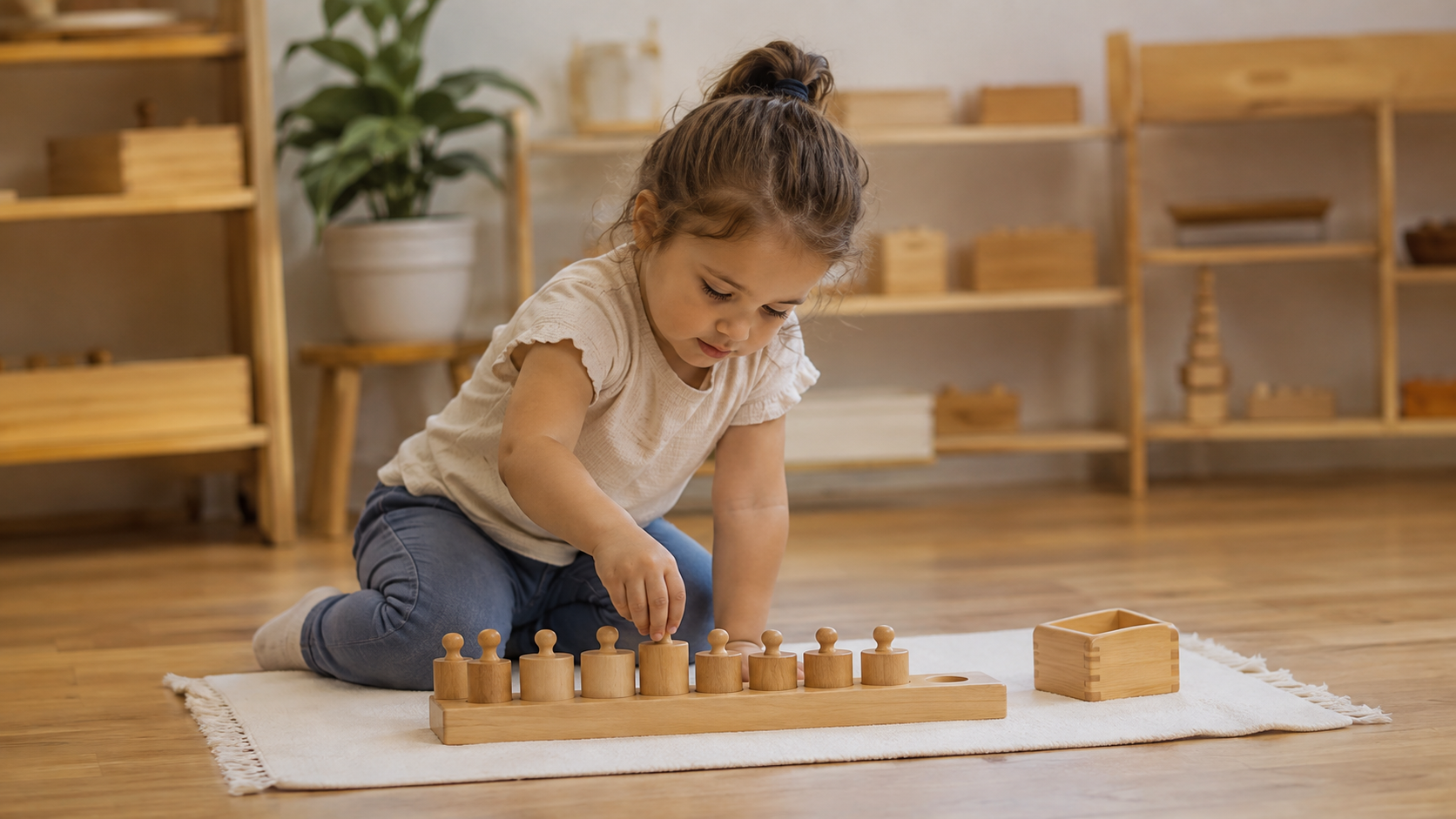
Walk into a Montessori classroom and the first thing you will notice is how calm it is. Children are spread around the room — one child polishing a small mirror, two working through a math material together, another tracing sandpaper letters with a finger. It looks less like a lecture and more like a busy, purposeful workshop.
A few things make it work:
- Real, hands-on materials. Montessori classrooms are full of beautifully made learning materials — beads for counting, movable letters for building words, objects for sorting by size and weight. They make abstract ideas (quantity, phonics, fractions) concrete and touchable, so a child discovers how something works rather than being told.
- Multi-age classrooms. Children of different ages learn side by side. Younger children learn by watching older ones; older children deepen their own understanding by helping. It is closer to how a family or a real community works than a room full of same-age children.
- Freedom within limits. Children choose their own work and how long to stay with it — which builds focus and self-motivation — but that freedom lives inside clear, consistent ground rules about respect, care, and grace.
- Long, uninterrupted work time. Instead of switching activities every fifteen minutes, children get long stretches to settle into deep concentration. That ability to focus is one of the most valuable things a child can carry into any school that comes later.
"But will my child actually learn to read and do math?"
Yes — and often earlier than parents expect, precisely because it is not forced. Because Montessori reading and math grow out of materials children choose and enjoy, the skills tend to arrive without pressure or tears. A child who builds words with movable letters is doing real literacy work; a child laying out golden beads is doing real math. It just does not feel like a worksheet.
Just as importantly, children come away with things a worksheet cannot give: independence, concentration, and a genuine love of learning that makes the next classroom — and the one after that — easier.
Is Montessori right for every child?
In our experience, the Montessori approach serves a very wide range of children well, because it is individualized by design. A child who needs more time is not rushed; a child who is ready to race ahead is not held back. Children who came from a more traditional setting settle in too — they are simply met where they are.
The best way to understand Montessori is not to read about it, though — it is to watch it. A quiet, focused classroom of young children doing real work tends to answer the question all on its own.
Curious what this looks like in person? Schedule a tour and come see a Montessori classroom in action, or explore our programs for ages 2 through 1st grade.