
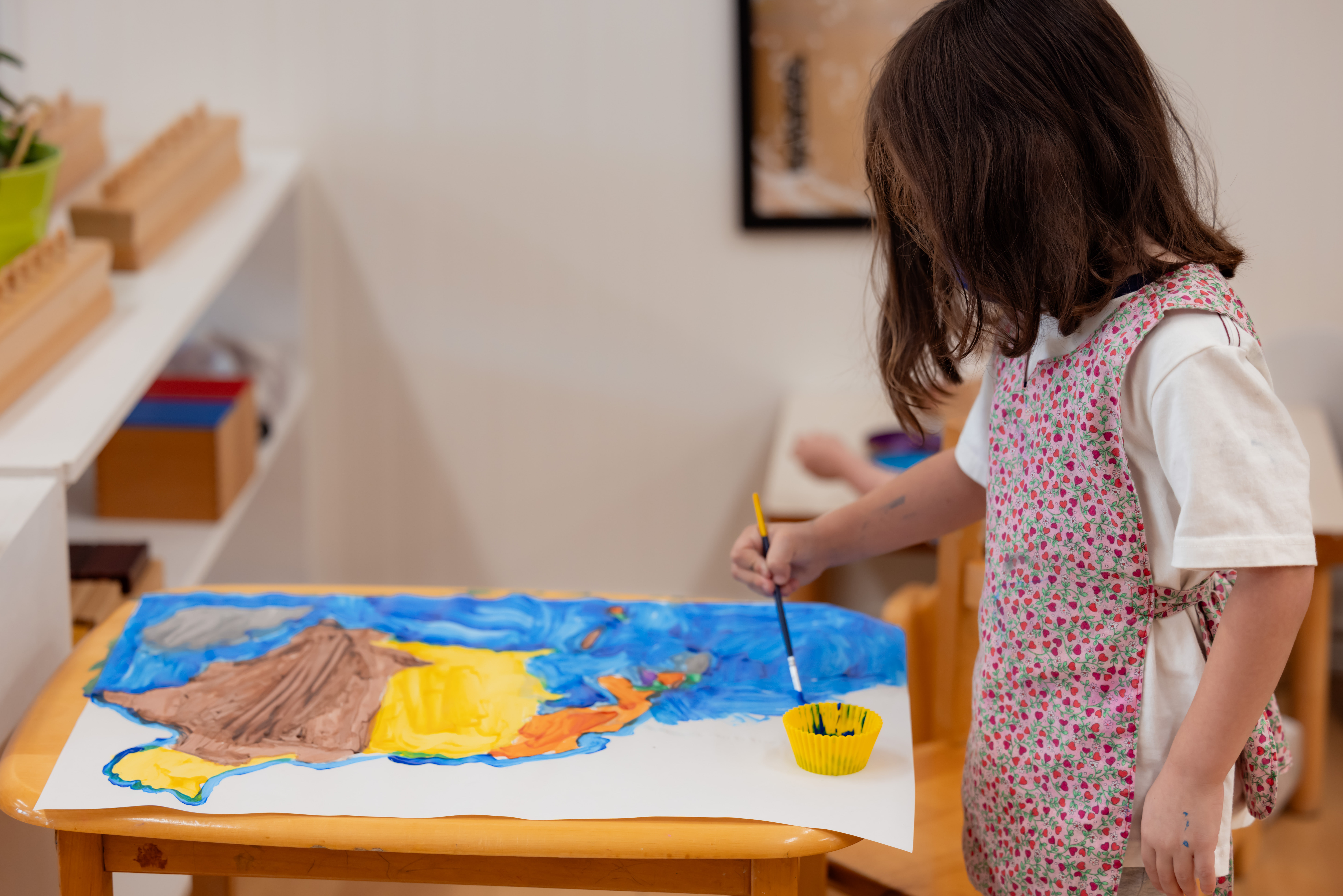
How does a parent prepare their child for an unpredictable future? In a rapidly evolving world, don’t we all want to give our children every possible advantage?
As parents, we constantly reflect on how we define success in our children’s lives. Is it about achieving financial security, or finding deep joy and purpose in the work they do? Is it about contributing meaningfully to our communities, or maintaining a lifelong curiosity?
Couldn’t it—and shouldn’t it—be a little bit of all of those things?
At Montessori of Brea, we believe an authentic Montessori education provides a proven, scientifically grounded pathway toward all of these goals. Preparing your child for the future isn't about guesswork; it's about systematically building the developmental foundations that support lifelong resilience, cognitive agility, and confidence.
The Pillars of Future Readiness
Here is how our authentic Montessori program transforms big goals into daily developmental outcomes for your child:
1. Concrete Mastery in Math and Literacy
Montessori provides a deep understanding of core mathematical and language concepts earlier than conventional methods. Using hands-on materials that match how the brain naturally learns, children move sequentially from concrete exploration to abstract reasoning. This sensorimotor integration builds the exact executive function and analytical skills that predict long-term academic confidence.
2. Radical Independence and Confidence
Building genuine self-reliance is at the core of our daily routines. Children are far more capable than modern adult-sized environments give them credit for. By preparing a classroom scaled entirely to their physical size, our trained guides step back, observe, and intervene only when necessary. This gives children space to solve their own problems, master self-care, and amaze both their parents and us with their capability.
3. Connection to the Larger World
Around age six, children undergo a cognitive shift, seeking to understand where they fit into the bigger picture. Our curriculum directly nurtures this developmental leap by exploring the universe, our solar system, the beauty of the Earth, and the vast diversity of life on it. We cultivate global awareness, empathy, and respect for our planet right when their young minds are actively seeking those answers.
4. Practice in Real Choice and Freedom
Freedom within a structured environment is a fundamental human need. By granting children meaningful choices in their daily work, we teach them how to identify what they need and how to self-regulate. The more practice children have making thoughtful choices in a supportive setting, the more capable they become at navigating complex decisions when adults aren't there to hold their hand.
5. Time Management & Accountability
Freedom in a Montessori classroom always walks hand-in-hand with responsibility. While children choose the order of their work, they are held accountable to clear expectations. A child may decide when to complete a grammar exercise during a work cycle, but they understand the expectation to complete it. This builds focus, task persistence, and self-discipline—skills that serve them for a lifetime.
6. Deep Exploration Over Rote Memorization
Rather than forcing children to memorize arbitrary facts for a test, we expose them to a broad landscape of scientific, geographical, and historical concepts. We give young learners the time and space to dive deeply into the topics that fascinate them, fostering genuine intellectual curiosity rather than temporary compliance.
Proven Outcomes for Life
Graduates of Montessori programs transition seamlessly into traditional private and public school settings. Because they have practiced self-direction and creative problem-solving from an early age, they tend to view challenges with innovation and adaptability.
In fact, notable figures across science, tech, and the arts frequently attribute their lifelong drive and innovative spirit to their early Montessori roots.
What the Research Tells Us
While Maria Montessori founded this method over a century ago, modern educational neuroscience continues to validate her findings.
The Hartford Study: A longitudinal study examining preschool students in a public Montessori magnet school found that while children entered with similar baselines, the Montessori students significantly outperformed their peers academically over time. Beyond academics, they demonstrated higher executive function, social understanding, and genuine enjoyment of their work.
The Milwaukee Transition Study: Research on students transitioning from public Montessori environments into traditional schools concluded that Montessori yields long-lasting positive developmental benefits. Furthermore, these students transitioned smoothly, adapting with high confidence and academic competence.
The High-Fidelity Factor: Studies comparing high-fidelity Montessori programs (where guides adhere authentically to traditional methods and materials) against conventional classrooms show that classic Montessori environments yield the highest annual learning gains. Authenticity matters.
A Community for the Whole Family
Montessori of Brea offers something rare in today's fast-paced environment: a true community for the whole family.
We bring together parents, educators, and children around a shared commitment to raising capable, compassionate human beings. In an age where busy professional schedules and long commutes often leave families feeling isolated, our school serves as a warm, supportive anchor—a place to connect, learn, and grow together.
Discover the Montessori Difference
Want to see how an authentic Montessori environment prepares your child for a bright, confident future?
Schedule a Tour Today to observe our classrooms in action!